“Waste is anything other than the minimum amount of equipment, materials, parts, and working time which is absolutely essential to add value to the product or service.”
— Taiichi Ohno
The Importance of Material Handling in Lean Manufacturing
Lean Manufacturing has one job: find the activities that add value to a product, and remove everything that doesn’t. This is simple in principle, but it was revolutionary in the manufacturing world.
Decades after Toyota proved the model, plenty of waste still hides in plain sight. It drags down profitability and productivity, and it quietly caps how much a plant can grow. One of the most overlooked sources sits right in the aisles: material handling. Every forklift trip, every manual lift, every cart waiting on an operator is a place where value leaks out.
Staying lean means looking at the fundamentals again with fresh eyes, then using the tools available today to close the gaps. Fork-free material handling is one of those tools.
The Toyota Production System
In the 1950s, Taiichi Ohno and Eiji Toyoda visited Ford’s plants in the United States to study mass production. The scale impressed them. The waste did not. They saw excess inventory, disconnected processes, and high defect rates. They also saw workers stuck in repetitive tasks and shut out of problem-solving. All of it added cost and made the operation slow to react when customer demand shifted.
Back in Japan, they built something different: the Toyota Production System (TPS). Instead of chasing volume, they went after waste. They introduced Just-In-Time (JIT) production, built quality checks into every step, and gave workers a real role in continuous improvement, or Kaizen. The result was a flexible operation that answered actual demand. That approach became the foundation of Lean Manufacturing and turned Toyota into a global leader.
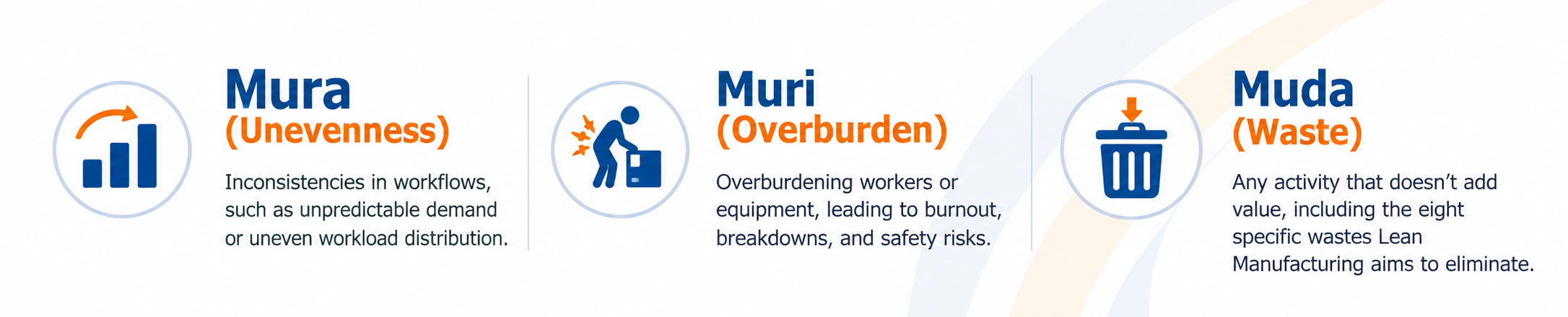
TPS sorts waste into three types: Mura, Muri, and Muda. Here is how each one shows up in material handling, and how a fork-free system answers it.
Three Types of Waste: Mura, Muri, and Muda
Mura (Unevenness)
Mura is inconsistency: unpredictable demand, uneven workloads, delivery that arrives in bursts instead of a steady rhythm. Uneven flow forces the line to either wait or scramble.
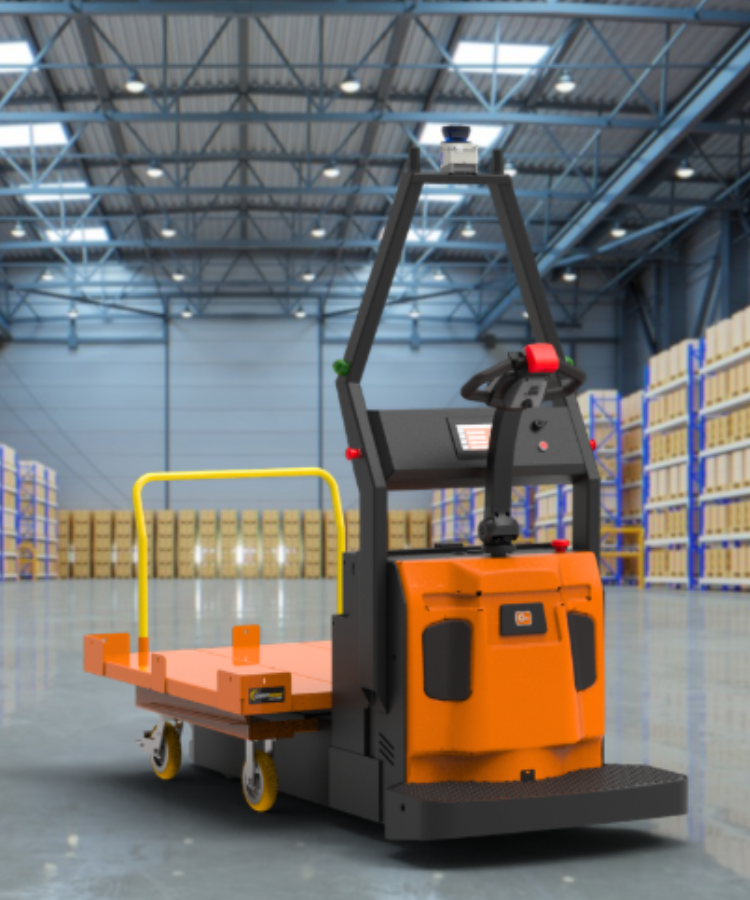
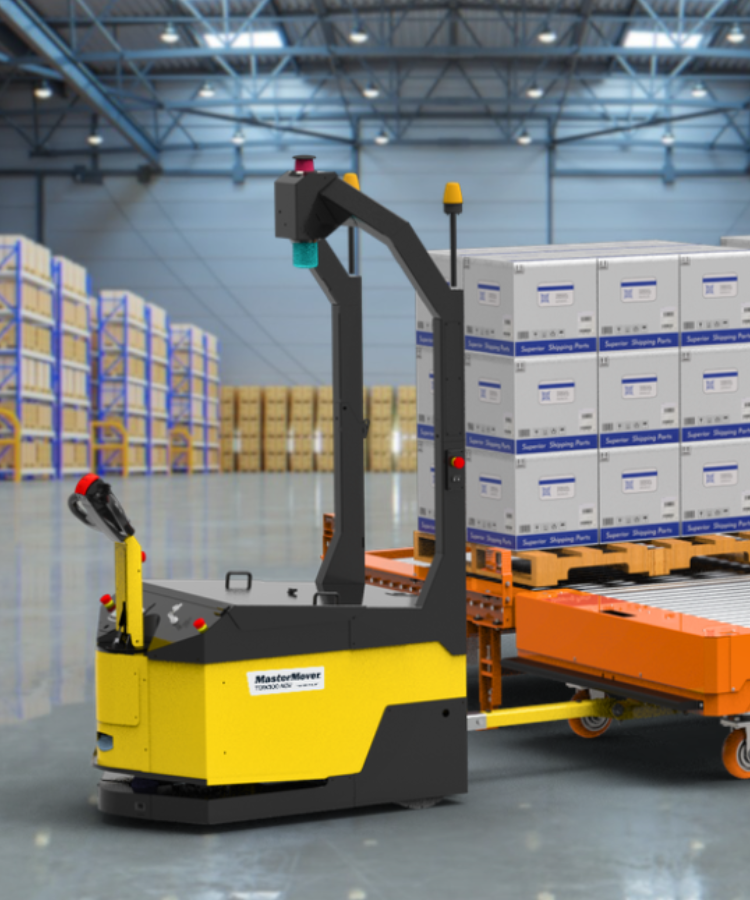
TugBot, our autonomous tugger, replaces that with a fixed cadence. It tows a full train of a carts along set routes and can run the same loop every shift, on time, whether it’s the first hour of the day or the third shift on a Friday. The line stops needing to guess when parts will show up. The MoveBot is our AMR, autonomously transporting any cart to its needed location without a needed route. No forklift needed.
Muri (Overburden)
Muri is overburden: pushing people or equipment past a safe, sustainable limit. It shows up as strained backs, worn-out machines, and near-misses.
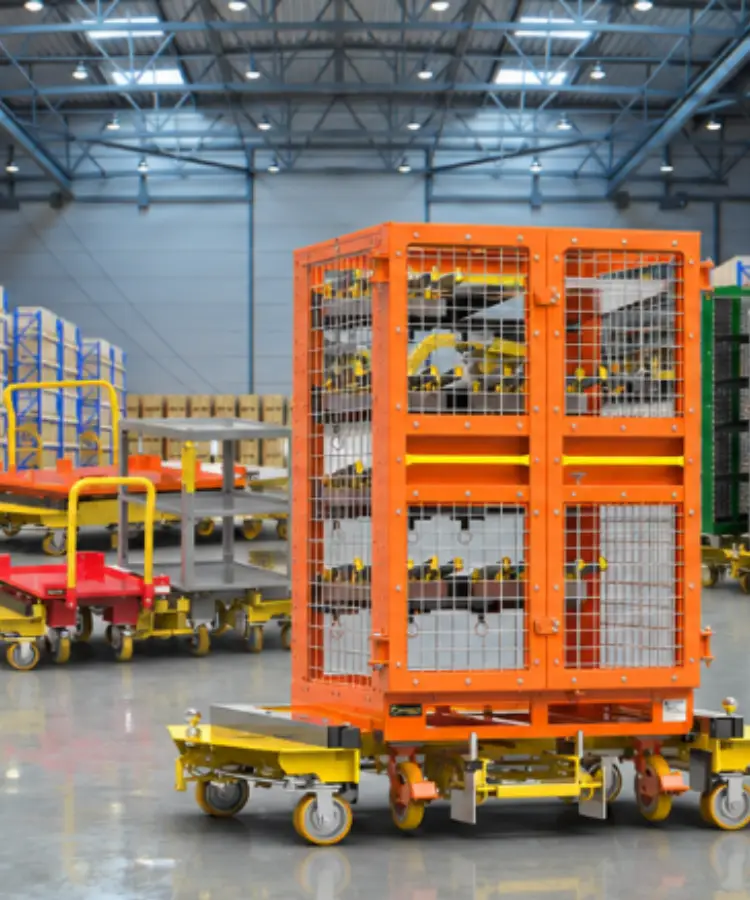
This is where the mother-daughter design earns its keep. Jtec’s all mechanical CarryMore system keeps forklifts away from employees and greatly reduces the strain of pushing a loaded cart around a facility. It continues to revolutionize facilities around the nation, increasing safety and efficiency at the same time.
8 Types of Muda (Waste)
Muda is waste in its most familiar form. Material handling touches nearly all of them.
- Defects. A wrong part at the line becomes scrap, rework, or a stopped station. Forklifts are notorious for damaging parts. With our mother-daughter tugger cart system, parts are safely transported through your facility in a train of carts rather than forks.
- Overproduction. Building more than the line needs ties up cash and floor space. The CarryMore mother/daughter system can feed the line in small, measured drops based on what is needed instead of large batches pushed ahead of demand to prevent forklift congestion or to make up for extra trips. This keeps production sized to what the line is actually pulling.
- Waiting. A line that runs out of parts stops making money. TugBot keeps an entire train of material moving autonomously on a set cadence. Forklifts heavily contribute to waiting by only delivering one pallet at a time.
- Unutilized Talent. Skilled people spend hours pushing carts or running forklifts, repeatable actions that automation was made for. The MoveBot safely automates those single-cart forklift runs and can navigate tight, awkward spaces. It safely delivers a daughter cart to its station on its own, which frees those workers for jobs that need real hands, problem-solving and continuous improvement.
- Transportation. Moving material farther than necessary adds cost and nothing else. One TugBot train carries what used to take several separate forklift trips, so the same material reaches the line in a single pass instead of a dozen scattered ones.
- Excess Inventory. Keeping too much inventory on hand eats capital and storage space. Make delivering your materials easier and more efficient and you will get a better visual on how much unnecessary excess you really have.
- Motion Waste. Every time a worker walks to fetch a part or bends to lift one, that’s motion without value. Our systems are built with this exact issue in mind. With our tugger cart systems, you can deliver 4-6 pallets at a time, rather than needing 6 different forklift trips to do the job.
- Excess Processing. Handling the same problems or loads two or three times is work none of your customers pay for. Too often do things get lost when transporting one pallet at a time with a forklift. Our system encourages organized routes and reduces unnecessary processing.
Get Forklifts Out of the Aisle
Waste in material handling is easy to miss because it looks like normal work: a forklift crossing a walkway, a worker lifting a cart, a line pausing for parts. Lean thinking says none of that is free.
A fork-free system built on CarryMore carts, TugBot, MoveBot, and BotBoss takes those costs off the floor and puts steady, predictable flow in their place. That’s the whole point of the mother/daughter advantage.