
Mastering the Human Side of the Forklift-Free Transition
In a lean environment, moving to a CarryMore® mother daughter tugger cart system is more about introducing the technology, such as Elemate all-mechanical lifting, zero-turn radii, ergonomics, and other benefits. For a plant manager, the most critical component is the person behind the hitch.
Transitioning to a forklift-free culture means moving your workforce from a reactive material mover mindset to a disciplined System Navigator role. We categorize this transition into three primary initiatives that turn tugger safety procedures into professional standards. This guide is a supplemental resource for equipment transition and does not replace the official safety and maintenance training.
1. Preventative Maintenance: The Morning PM Ritual
In the forklift world, drivers often wait for a mechanic. A System Navigator takes ownership of their “vessel” before the first lap of the day.
-
Daily Discipline: Success begins with a morning PM (Preventative Maintenance) schedule. This isn’t just a safety check; it’s a performance audit to ensure the “pulse” of the plant remains steady. For example:
-
Tongues and Hitches: Navigators verify the coupler is tight and the pin and ring are securely seated. They ensure the drag links and tie rods underneath aren’t bent or damaged from previous shifts.
-
Lubrication Standard: A smooth system is a silent system. Navigators follow a schedule to spray white lithium grease into the internal mechanisms and the pawl-and-ratchet assembly.
2. Elite Operation: Mastering the “Long Load” Dynamics
The most significant shift for a former forklift driver is the change in spatial awareness. Their world is now defined by the 15 to 20 feet of trailing equipment behind them.
Certified Operators Only: Because of the nuances of speed, braking, and vision, it is vital that only trained operators run the system. An untrained substitute lacks the “train-brain” required to manage a multi-unit load.
The Logic of Alignment: Since a daughter cart obscures the forward view during loading, operators use visual hardware guides. By aligning the cart edge with the bolts on the mother cart frame, they verify the path from the side rather than “eyeballing” it.
Momentum Over Muscle: To eliminate push-pull injuries, we teach mechanical advantage. Operators align the cart, build slight momentum, and let the cart “climb” the wing onto the rollers. It’s smarter work, not harder work.
- The Mechanical Lock: When loading a daughter cart into a mother, you don’t “baby” the cart. You step back and push with authority to engage the trip pad and securely lock the cart in place. If you don’t hear that “click,” the system isn’t safely engaged.
Brake Standardization: The brake on daughter cart casters must always face the operator’s foot. In an emergency, the interface must be exactly where the brain expects it to be.
3. Planned Predictability: Routes and Pedestrian Safety
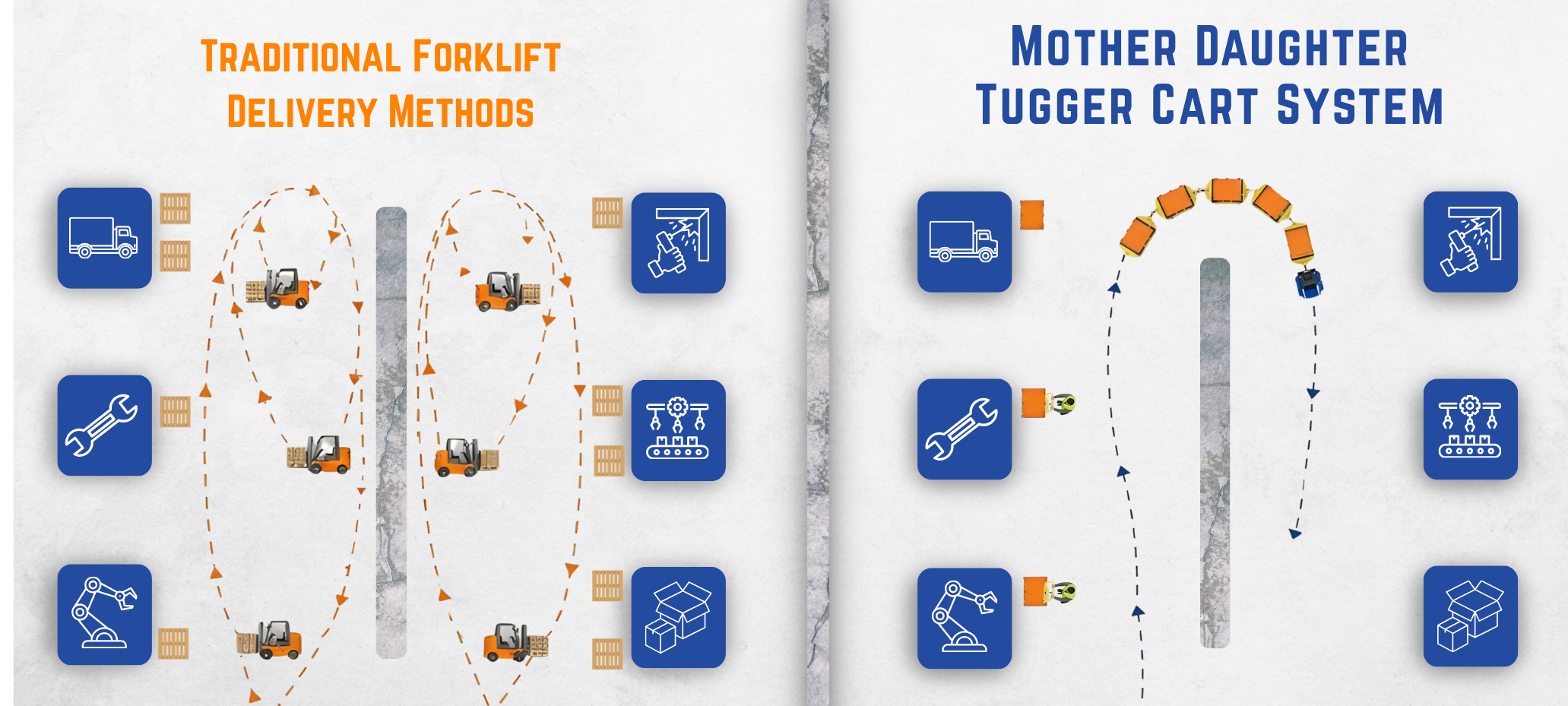
Forklift environments are defined by the “orange spaghetti chaos” in the image above: reactive, agile, and unpredictable. A Jtec environment is defined by a predictable pulse.
Dedicated Lanes: By establishing a dedicated tugger lane and a separate walking lane, you remove the guesswork for pedestrians. When everyone knows where the “train” belongs, anxiety levels drop and efficiency rises.
The “4-Way Stop” Corner: Navigators treat corners with the same discipline as a 4-way stop. Just as a forklift should stop and assess, a tugger train manages corners as high-awareness zones. This is especially critical given the “long load” dynamics; the driver must ensure the entire tail of the train can clear the intersection safely.
Predictability is Safety: Planned routes allow both drivers and pedestrians to “get to know” the flow. When the route is predictable, the “near-miss” culture of the forklift floor disappears.
Managing the Change: Tips for Leadership
The transition requires management to be firm on the new systemic approach:
Stay with the Flow: Unless it is a true emergency, resist the “quick fix” forklift. It undermines the train’s discipline. If a station is low, analyze the loop timing and route efficiency instead.
Celebrate the “Smooth Swap”: The seamless exchange of a full daughter cart for an empty one is the “Grand Prix pit stop” of lean manufacturing.
Visual Reinforcement: Keep your “Ideal State” diagrams visible. Remind the team the team that every scheduled trip represents 4 to 6 fewer forklifts congesting their workspace.